
Nashville People Directory Routes
Nashville people directories are split by the role or time period being searched. Metro departments publish their own staff lists. Metro Nashville Public Schools keeps school-level faculty and staff pages, while Vanderbilt provides a university finder. Property, permit, license, and business indexes work as focused name directories. Metro Archives supplies the deepest route for people who lived in Nashville in earlier generations.
| Directory | Who appears | Keeper | How to use it |
|---|---|---|---|
| Nashville Metro department pages | Current Nashville staff by agency or division | Nashville Metro departments | Browse a department page; free |
| Nashville MNPS school directories | Nashville teachers and school staff | Individual MNPS schools | Keyword, first name, or last name; free |
| Vanderbilt People Finder | Nashville university people | Vanderbilt University | Last name required; first name optional |
| Nashville Assessor and Parcel Viewer | Assessed property owners | Davidson County Assessor and Metro GIS | Name, address, map, or parcel; free |
| Nashville city directories | Past Nashville residents and firms | Metro Archives | Name from 1853; street from 1910; archive access |
| Nashville license and entity searches | Licensees, entities, agents, and local firms | Tennessee boards, Secretary of State, County Clerk | Resource-specific public searches |
Start with the Nashville directory that reflects the person’s known role. A Nashville teacher’s school page is more precise than a broad name index. A parcel roll can distinguish an owner, but it does not prove where that person lives. For someone from an earlier era, city directories, yearbooks, newspapers, cemetery files, and oral histories are stronger than a current web listing. These Nashville sources describe different roles, so a name should be checked against dates, places, and affiliations.
Nashville Metro Staff Directories
Nashville has no verified, unified directory for every Metro employee. Department pages are the reliable route. Human Resources, the Metro Council, Mayor’s Office, Codes, Finance, Planning, and Law publish browse lists that may group staff by division. Entries commonly show a name and title, with a direct work phone or email on some pages. Elected-official rosters and agency contact lists answer similar questions, but each reflects one office rather than the whole consolidated government.
The Metro Human Resources contact directory shows the division-based format used by one Nashville department.
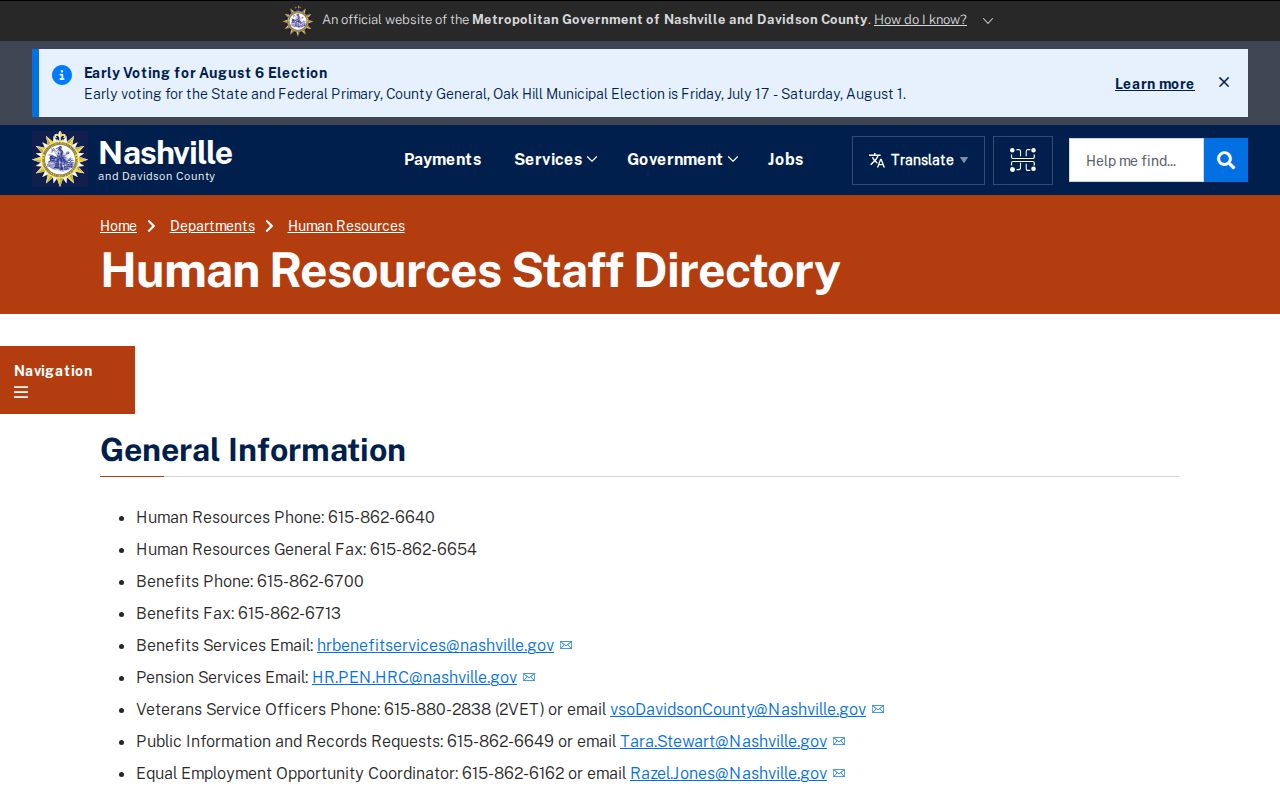
The visible Nashville HR list also identifies Tara Stewart as Data Compliance Manager and Custodian of Records, with the public-information line at 615-862-6649. That makes the Nashville page both a staff directory and a route to the office responsible for HR records.
| Person | Full or displayed name |
|---|---|
| Role | Position or function within the division |
| Division | The Nashville Metro unit that places the entry in context |
| Work contact | Direct phone or email when the department publishes it |
| Fallback | Department main line, records custodian, or Metro Clerk routing help |
If a person is absent, call the Nashville department’s main number before assuming the directory is complete. Metro Clerk can route many Nashville executive-department requests, but independently governed offices keep their own records. The detailed custodian and request rules belong with Nashville public records access, not with a staff listing.
Search Nashville School Directories
Nashville MNPS directories live on individual school sites. That structure is useful when a Nashville school is known, but it does not function as one districtwide surname list. The Nashville School of the Arts directory showed 48 entries at the time of research and displayed ten entries per page. Its search form accepts all three fields below, and none was marked as required.
| Search field | Input | Required | Use |
|---|---|---|---|
| Keyword | Text | No | Broad term, such as a role or part of a name |
| First Name | Text | No | Person’s given name |
| Last Name | Text | No | Person’s surname |
The Nashville School of the Arts staff search provides a concrete MNPS directory example.
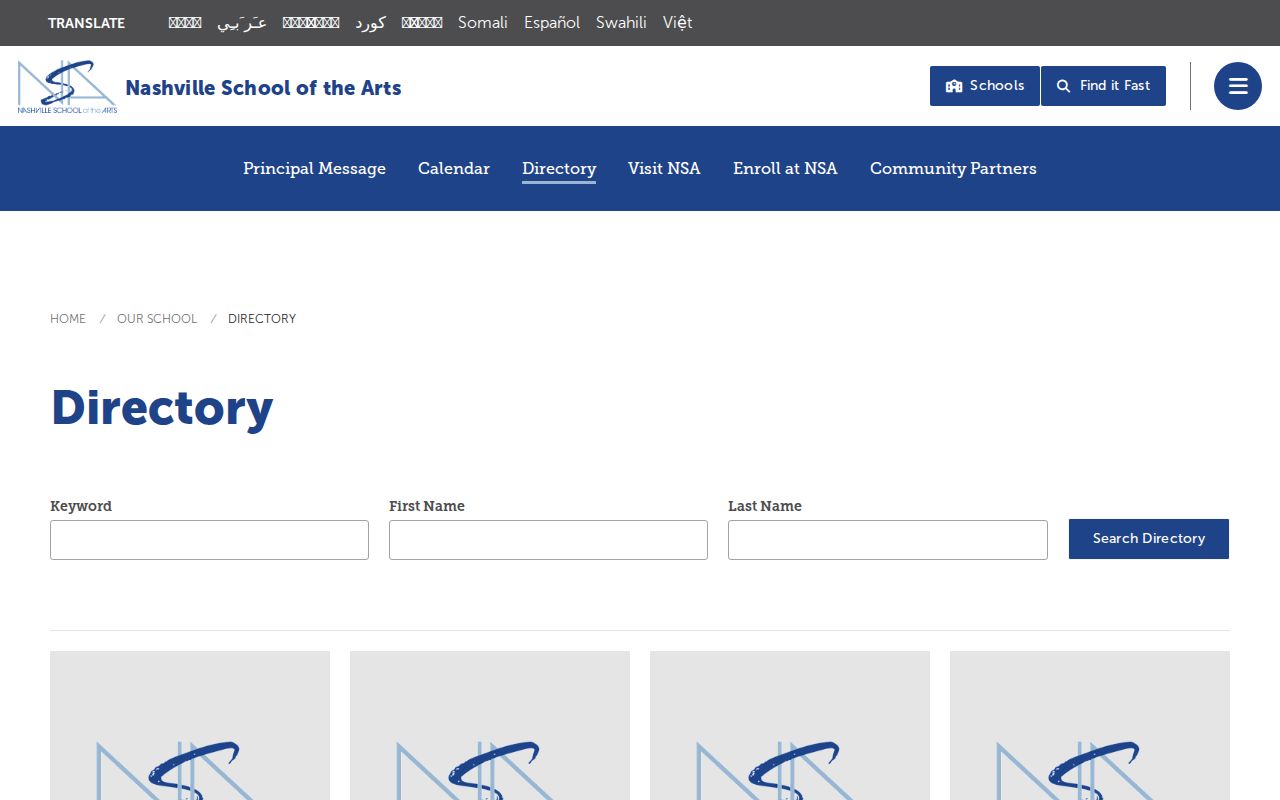
A sample entry listed Jeffrey Anderle, the title English Teacher, and an email label with a Contact link. Other visible roles included assistant principal, campus support, paraprofessional, nutrition services, and classroom associate. Private home addresses and private phone numbers were not shown. When a search fails, browse the school’s paginated results, verify spelling, then use its main office at 1250 Foster Avenue or 615-291-6600.
Vanderbilt Nashville People Finder
Vanderbilt’s public finder adds a large Nashville institutional directory. The embedded Nashville search requires a last name and accepts an optional first name. University documentation describes typical results as name, email, department name and phone, and location. Those fields can separate two people with the same surname by department, yet they should be read as current professional contact details rather than personal residence data.
The Vanderbilt business school contact page displays the public people-finder form used for this Nashville directory.
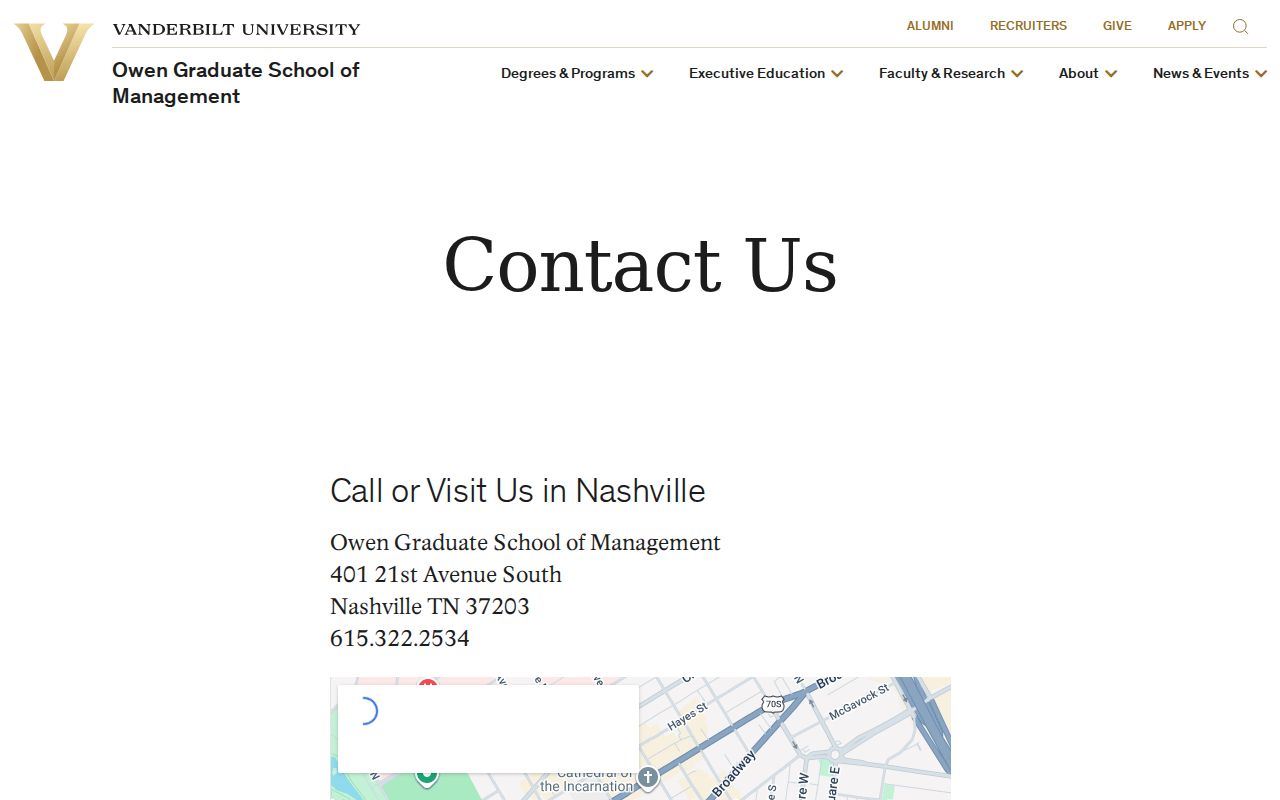
The required surname field makes a broad browse impossible. Try a full surname first, then add the given name to narrow a common result. Vanderbilt’s large local footprint means this directory can establish a campus or departmental tie, while yearbooks and special collections can add older student or faculty context.
Nashville State Service Directory
Tennessee 411 should be used as a Nashville government service directory, not described as a verified employee phone book. Its form accepts a full or partial Service Name plus an unlabeled filter. Results are organized in Service Name, Department, and Phone Number columns. That makes the tool useful for finding the Nashville state office that handles a subject, then asking that office for the right staff contact.
The Tennessee 411 directory shows the search box and service-result columns directly.
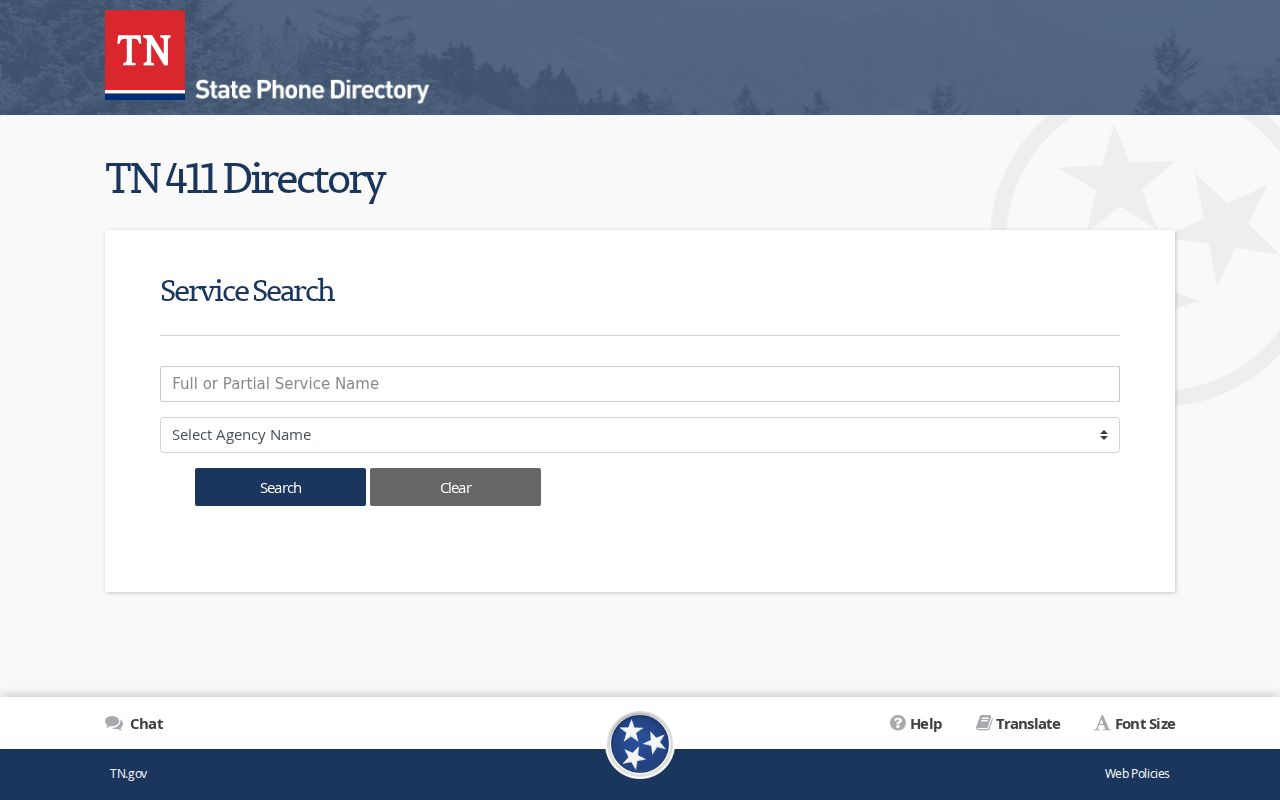
A service result does not establish that a named person works there. Use the listed department phone to request a current contact or browse the agency’s own roster. This distinction matters in Nashville, where state offices share the city with Metro departments and university institutions.
Note: Tennessee 411 routes Nashville callers to services and departments; it does not establish a current named employee roster.
Nashville Property Name Directories
Davidson County’s Assessor Property Search and Nashville Metro Parcel Viewer act as owner directories. The Nashville assessor supports real estate, name, address, map, and parcel searches. Parcel Viewer adds a starts-with current-owner search, ownership and assessment histories, zoning, permits, and an export function. Broad Nashville result sets are capped at 4,000 parcels, so a common surname needs a first-name fragment, address, ZIP code, or other filter.
A parcel entry identifies the assessed owner and the property’s physical address, called the situs address. The owner mailing address is where tax correspondence goes and may differ from the situs. Neither field alone proves a home address. For the recorded chain, the Register of Deeds index lists grantors, who transfer an interest, and grantees, who receive one. Its start year is not published, and its portal requires an account. Counter, copy-request, phone, and email routes remain important when the online directory is not enough.
Nashville Metro Codes adds an owner-and-contractor directory through ePermits. Nashville searches can use permit number, address, APN, current owner, owner, contractor, or prime contractor. Results may show permit type, address, property owner, contractor, and status. This is project-specific evidence. It does not prove that a contractor owns the parcel or that an owner performed the work.
Note: Nashville property directories distinguish assessed owners, deed parties, permit owners, and contractors; the same name does not make those roles interchangeable.
Nashville License and Business Directories
Nashville professional and business lookups cover narrow, well-defined groups. Tennessee’s Secretary of State search identifies Nashville entities by Business Name or Secretary of State Control Number. Results can supply status, entity type, principal office, registered agent or office, and filing history. A registered agent receives legal mail and is not necessarily the owner. Davidson County Clerk’s New Business List is the Nashville counterpart and can be filtered to Davidson, then sorted by business or owner name and date.
Verify.TN and board-specific systems provide license directories. Health verification can search first, middle, or last name, city, ZIP, state, profession, or license number; profession and CAPTCHA are required. Commerce searches cover individuals and firms in fields such as contractors, insurance, barbering, cosmetology, and other regulated boards. A Nashville license result may show status, expiration, or discipline, but available fields vary by board.
- Use the legal entity search for formation and filing status.
- Use the County Clerk list for a Davidson business-license trail.
- Use the issuing board for current professional standing.
- Use ePermits for a person or firm tied to a specific project.
Note: A Nashville license or business directory entry proves the listed administrative role, not personal ownership beyond the source’s terms.
Nashville Directory Geography Since 1853
Metro Archives holds Nashville city directories from 1853 through 2011. The early volumes are name directories. Beginning in 1910, they can also be searched by street address, creating a reverse route from an old house to its listed occupant. An older microfilm inventory identifies runs for 1853–1861, 1865–1882, 1886–1918, 1920–1922, 1924–1926, and 1928–1933, while the current Archives description controls the total collection span.
The geography changes the meaning of a missed result. Before Metro consolidation in 1963, the Nashville volumes did not cover all Davidson County, though some listings reached beyond the old city limit. A suburban county resident may be absent from a Nashville volume without being absent from local records. Street names and numbers also changed. Pair the printed entry with deeds, plats, Sanborn maps, permits, Historic Commission street-name reports, and modern parcel data.
- 1853
- The surviving Nashville city-directory run begins with name-based access.
- 1910
- Street-address searching becomes available alongside resident and business names.
- 1963
- Metro consolidation makes Nashville and Davidson County overlap in current government, though older directory boundaries still matter.
- 2011
- The city-directory holdings described by Metro Archives reach their latest year.
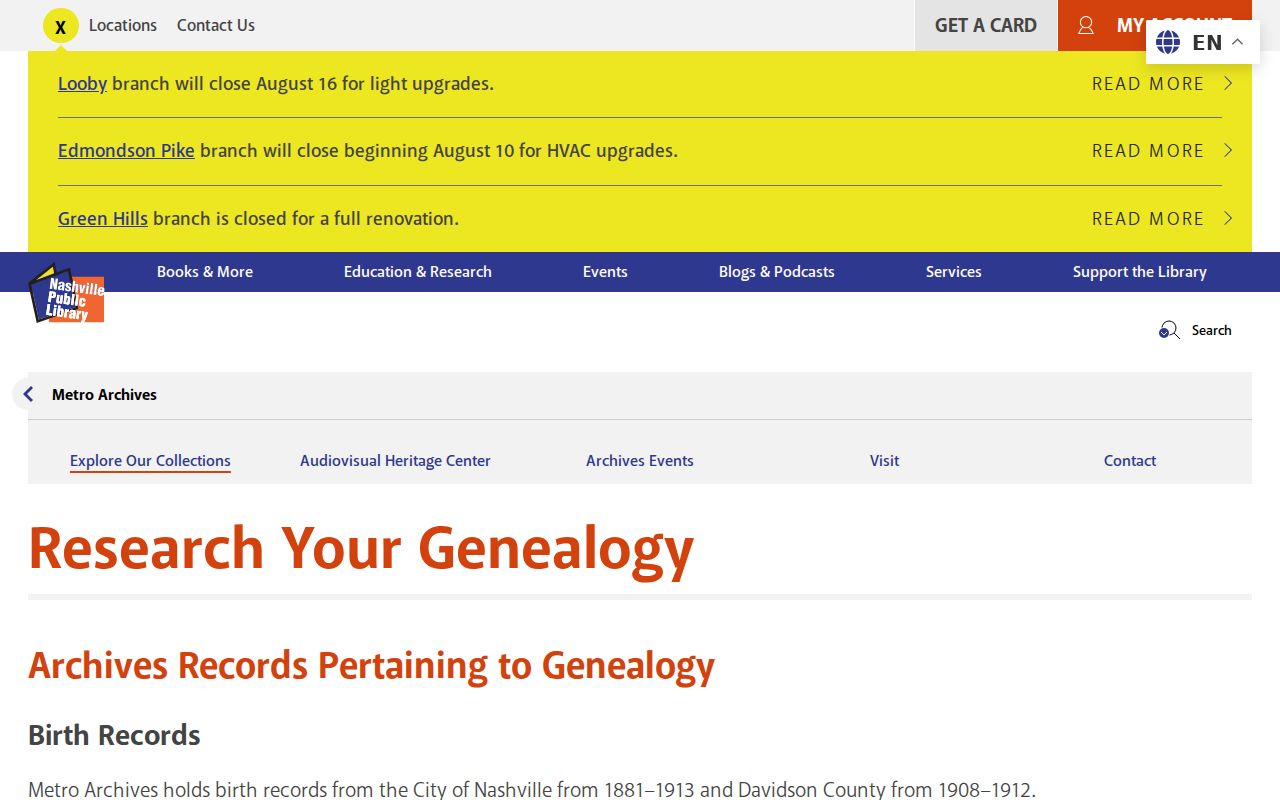
The Metro Archives genealogy collection states the city-directory dates and describes Nashville’s local vital, marriage, cemetery, naturalization, will, and yearbook holdings.
Online discovery is only the first channel. Some special-collections items are closed-stack and noncirculating. They require a research application and staff pull, with no pulls during the final 15 minutes. Ancestry Library Edition is available only on a Nashville Public Library public computer, while HeritageQuest and local databases provide other routes.
Nashville Community Memory Directories
Formal name lists do not preserve every Nashville community equally. The African-American Marriages Index covers 1789–1905. The Enslaved and Free People of Color Database draws names from Davidson County will books dated 1780–1865. Nashville Globe obituaries cover 1907–1918 in the index, while the newspaper itself extends farther. Mount Ararat Cemetery’s original interment records were lost, but a partial Archives listing reconstructs part of that community record.
The Nashville Public Library Digital Collections adds oral histories, photographs, civil-rights collections, neighborhood files, music history, veterans’ stories, and sacred-site research.
Century III, Homecoming ’86, Music Row, Veterans History, Union Station, and HNI interviews supply associates, schools, churches, family ties, and neighborhood details that a printed directory may omit. The HNI collection includes 34 interviews, of which 29 survive, recorded in 1980–1982. Union Station includes 112 interviews from 1976–1977 plus newspaper abstracts. Use these sources to test identity, not to force a match based on name alone.
Yearbooks form another people directory. Metro Archives indexes donated elementary, secondary, and college holdings from 1900–2017. Cemetery resources include Nashville City Cemetery, Mt. Olivet, Mount Ararat, and the Davidson County Cemetery Survey. Newspapers include the Tennessean archive, Nashville Banner microfilm, Nashville Globe, and obituary databases. Together they can place a person in a class, congregation, family, trade, or neighborhood.
Nashville Directory Gaps and Fallbacks
No authoritative, comprehensive current Nashville white-pages or reverse-phone directory was verified. The research also found no public directory covering all alumni, chamber members, neighborhood rosters, congregations, or unions. Private rosters may exist without being open to general browsing. Avoid treating a commercial compilation as an official source, since copied entries may be stale, merged, or detached from their original context.
Use a documented fallback chain. For a public staff member, contact the department. For a school person, browse the specific school and call its office. For an older resident, ask Metro Archives for the right city-directory year, microfilm run, yearbook index, newspaper, or cemetery finding aid. For a professional or firm, use the issuing board, Secretary of State, County Clerk, or permit system. For a property party, move between the assessor, Parcel Viewer, Register of Deeds, and office counter.
- Write down the role, place, and likely date before choosing a directory.
- Record exactly what the entry says, including title, address type, and source date.
- Check a second Nashville source that measures a different role or event.
- Use staff, counter, phone, email, library, or archives access when the web search ends.
Note: When a Nashville directory stops online, a department, school, library, archive, or records counter may still hold the needed source.