
Trace People Through Nashville Records
A useful Nashville search begins with the fact already known. A current or old street address points toward the Assessor and Metro Parcel Viewer. A full name can be tested in separate civil, criminal, probate, Chancery, business, license, and custody systems. A death date or family link belongs with vital records, wills, obituaries, and cemetery sources. No single Metro portal joins those trails because each elected clerk or department keeps its own files.
Start broad, then preserve the role attached to each result. An assessed owner, deed grantee, court plaintiff, permit contractor, registered agent, and cemetery lot owner may share a name without being the same person. Middle names, dates, parcel numbers, case numbers, and known associates help separate them. Nashville's official records provide the best proof of what an entry means, while a commercial compilation may be stale or merge several people.
- Search the free Assessor or Parcel Viewer when an address, parcel, or owner name is known.
- Check civil, probate, criminal, and Chancery portals separately, keeping every case number.
- Use the Register of Deeds index or office request route to connect owners across recorded instruments.
- For a deceased person, pair probate with Metro Archives vital, marriage, will, newspaper, and cemetery holdings.
- When a web index ends, contact the exact custodian, Metro Archives, or Tennessee State Library and Archives.
That sequence leaves a paper trail that can be checked. It also makes clear when a result is only a lead rather than proof.
| Search source | Best use | Verification value |
|---|---|---|
| Official Nashville portal | Find the office's current index entry | Strong when the custodian confirms it |
| Counter or records request | Reach files or copies not shown online | Best route for certified material |
| Commercial compilation | Generate a broad personal lead | Must be checked against an official source |
Nashville Records Offices and Searches
Nashville and Davidson County have shared a consolidated Metro government since 1963, yet record custody remains divided. The Register of Deeds handles land instruments. The County Clerk covers marriage and local business material. The Assessor maintains the assessment roll, while Metro GIS publishes the Parcel Viewer. Court records split again among civil, criminal, and Chancery clerks. The Nashville public records system explains the access rules and request process in full.
The three offices below are practical starting points. Calling the wrong counter can add days, so name the record type and date range before asking where to submit a request.
Davidson County Register of Deeds
300 Deaderick Street
Nashville, TN 37201
615-862-6790
Davidson County Clerk
700 President Ronald Reagan Way, Suite 101
Nashville, TN 37210
615-862-6050
Metro Clerk Records Office
1 Public Square, Suite 205
Nashville, TN 37201
615-862-6770
Metro Clerk routes many executive-department requests, but it is not a universal custodian. Courts, schools, Sheriff, Health, County Clerk, Register of Deeds, and several other offices use their own channels.
Nashville Parcel Search Links Owners
The free Metro Parcel Viewer offers one of Nashville's strongest address-to-name paths. Search by a parcel address or intersection, a current owner's partial name, a street, or a parcel ID. Table filters can narrow city, ZIP, zoning, acreage, sale price, or sale date. Results can be sorted and exported, but the tool caps them at 4,000 parcels. Broad surnames should be narrowed before export.
The official Parcel Viewer screen shows how these search modes share one map workspace.
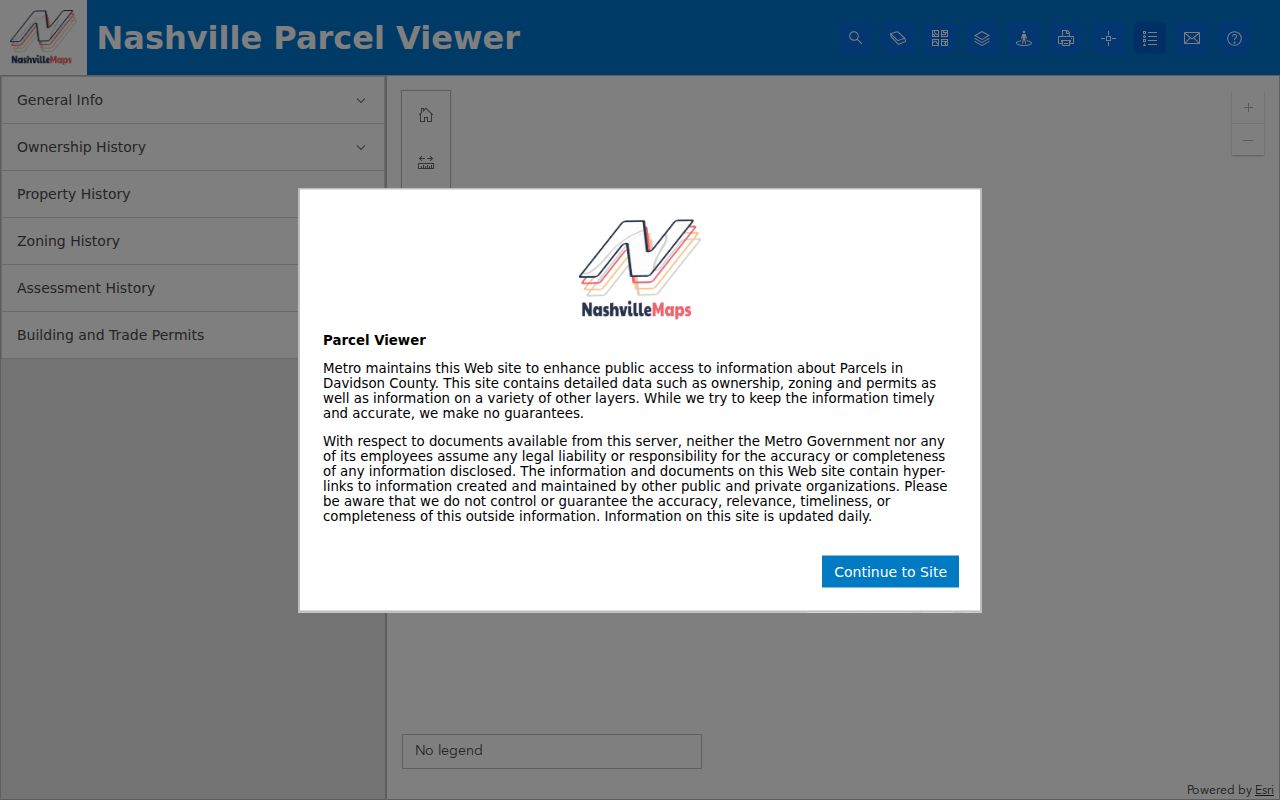
Open a parcel's details to move through ownership, property, zoning, assessment, and permit history. Keep the parcel ID. It is more stable than street spelling and helps connect the assessor record to deeds or permits.
| Nashville search mode | Useful input | What to save |
|---|---|---|
| Current owner | Beginning of an owner name | Owner role and parcel ID |
| Parcel address | Street address or intersection | Situs address and history |
| Parcel ID | Full numeric identifier | Assessment and permit links |
| Table filters | ZIP, zoning, sale range | Exported candidate set |
Note: A tax mailing address may identify a nonresident owner; it is not proof that the person lives at that address.
Nashville Deed Search Continues Offline
The Davidson County Assessor Property Search supports real estate, name, address, map, and parcel routes. Name searches use a surname-first form such as “Doe, John,” while parcel numbers keep their zeroes. It identifies assessed ownership, not the recorded transfer itself. The Assessor search screen makes the choice between owner, address, map, and parcel clear.
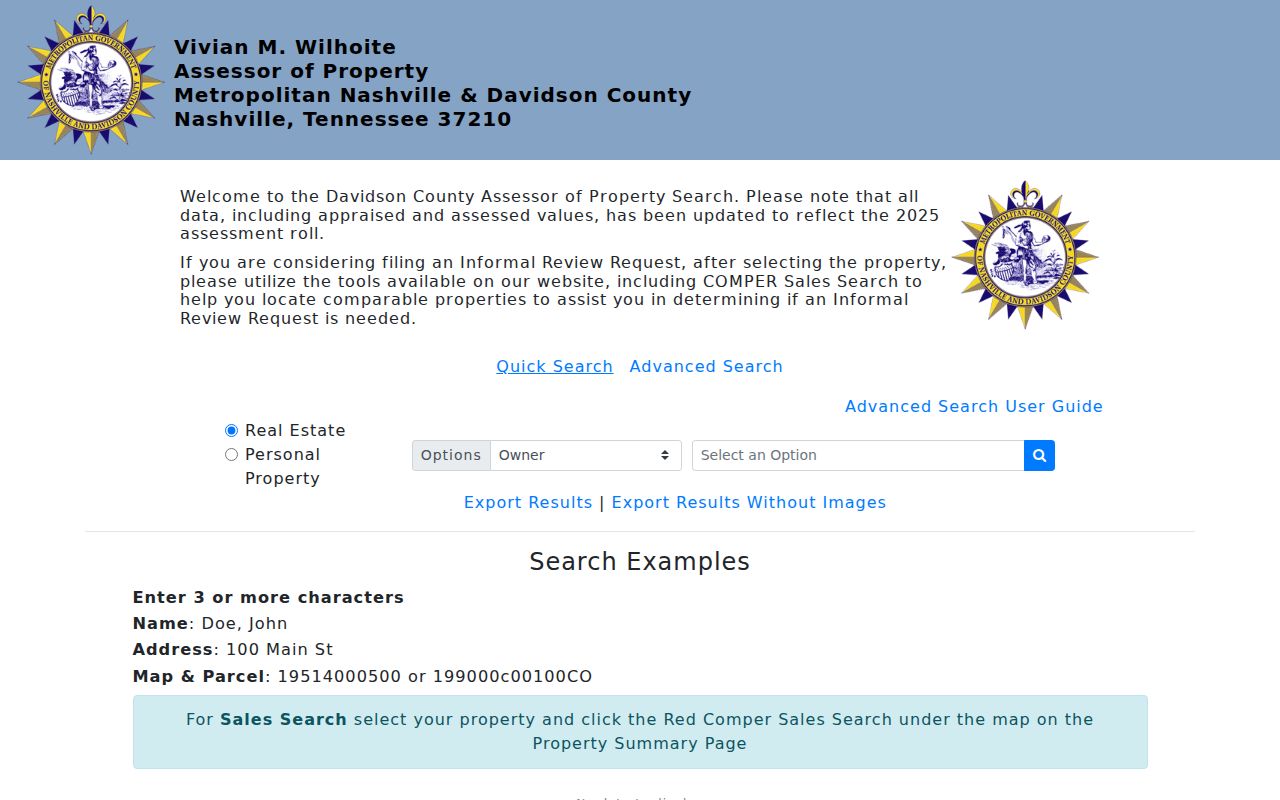
For the deed chain, switch to the Davidson recorded-document portal. It requires an account, password, and credit-card registration. The office does not publish the index start year or current image price on its unauthenticated pages, so the safest fallback is the Register of Deeds copy page, request form, phone, email, or counter.
The subscriber gateway shows why a Nashville name search may need an offline second step.
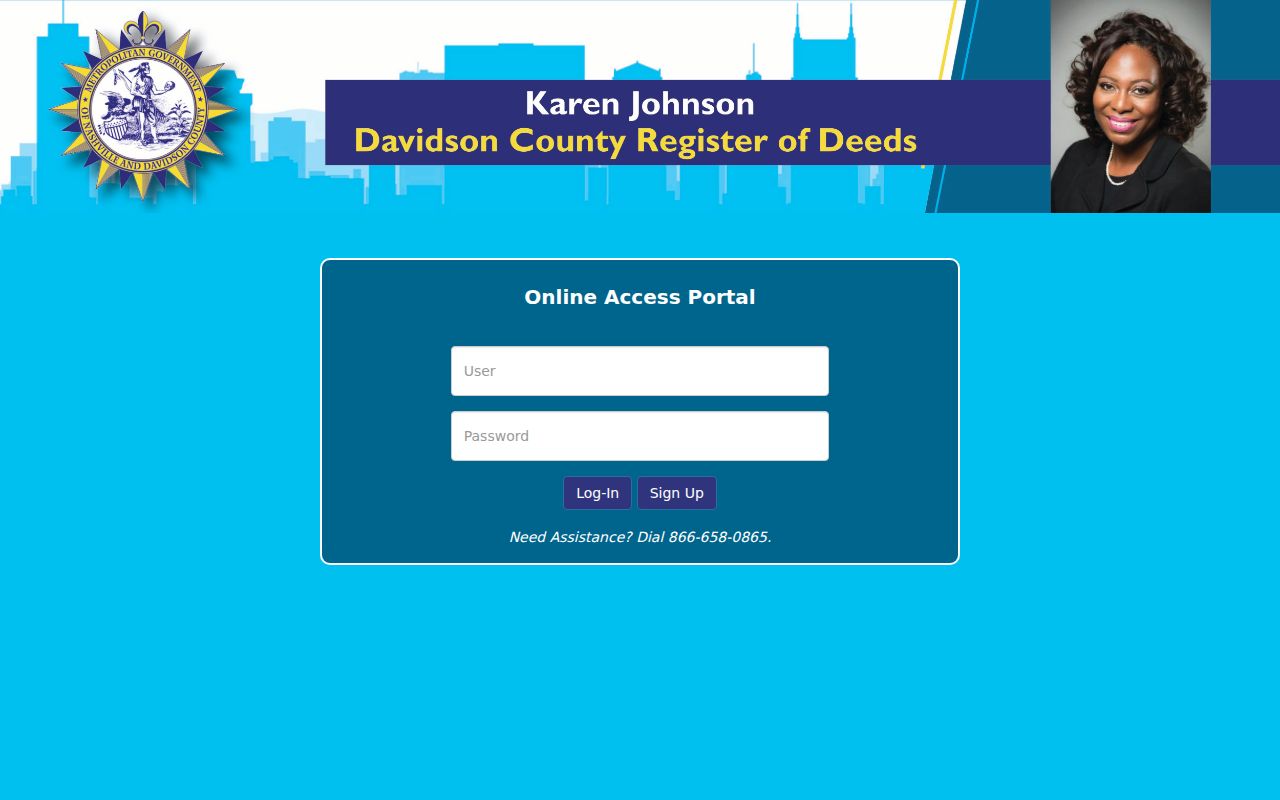
Once inside, search grantors and grantees, the parties transferring property, then save the legal description and document or book-and-page number. The system was installed in 2017, but that launch date must not be mistaken for the first indexed year.
- Grantor
- The person or entity giving an interest in property.
- Grantee
- The person or entity receiving that interest.
- Situs address
- The physical location of the parcel.
- Legal description
- The recorded wording that identifies the land, even when a street name changes.
Search Nashville Court Records Separately
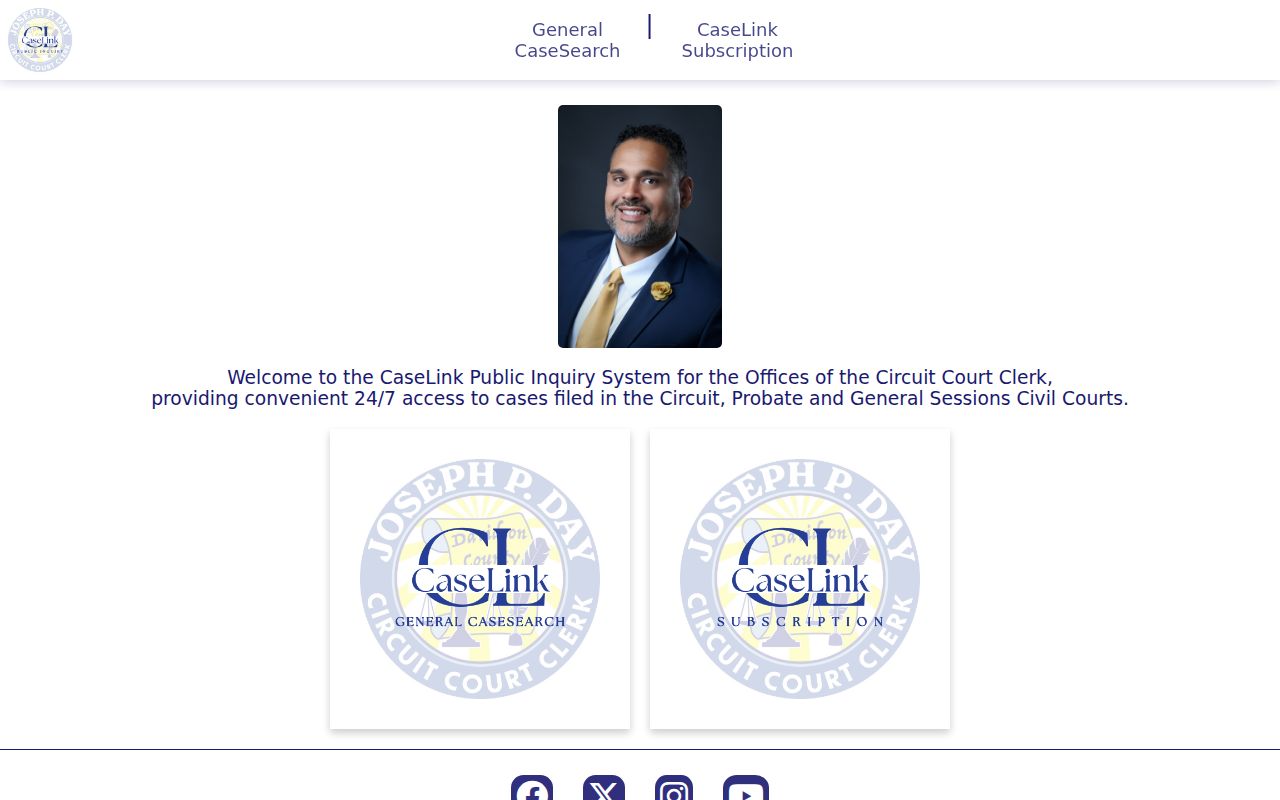
Nashville has no single trial-court party search. Civil, Probate, and General Sessions Civil CaseSearch accepts party name, party role, court office, and a filing-date range. Free results show parties, case type, filing date, and case details, but not document images. CaseLink subscribers receive advanced access and select images.
The civil search form shows why choosing both the office and party role can cut down same-name results.
Criminal and General Sessions Criminal cases use a different portal. A date of birth may help distinguish similar names. Expunged cases are excluded, and pre-1980 records require a call or counter visit. Chancery files and tax-sale litigation belong with the Clerk and Master. Tennessee's appellate Public Case History covers appellate records filed after September 1, 2006, not every trial court.
| Nashville court source | Record scope | Online reach | Fallback |
|---|---|---|---|
| CaseSearch | Circuit, probate, civil sessions | Free index and details | Clerk request by case number |
| Criminal Public Case Search | Criminal and criminal sessions | Legacy from 1980; later CJIS dispositions | Call or visit for older files |
| Clerk and Master | Chancery and delinquent tax | Search, subscription, file room | File-room request |
| PACER | Middle District federal cases | Account and per-page charge | Federal clerk copy request |
Note: A court index is a case locator, not a finding about fault; read the disposition and verify the file with the clerk.
Nashville Criminal Search Needs Context
The Davidson Criminal Public Case Search separates Legacy and CJIS data. Legacy coverage begins in 1980. General Sessions dispositions begin January 11, 2000, and state trial dispositions begin July 11, 2000. Search fields change by selected search type, with first name, last name, and optional date of birth among the core inputs.
The criminal portal places those identity fields together, making the date-of-birth check easy to see.
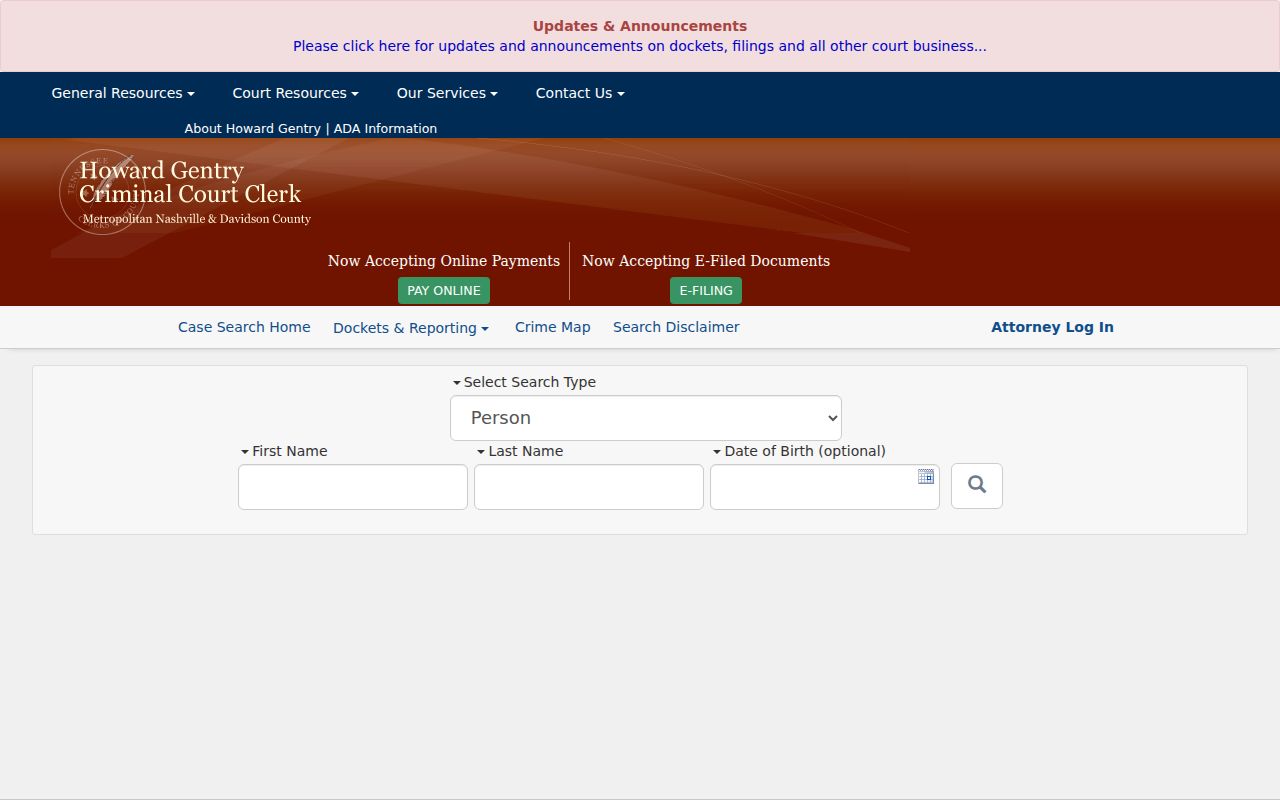
Results may show an address supplied at arrest or booking, alleged offenses, citations, and later dispositions. That address can be old or wrong. A name without a matching birth date should be confirmed with the Criminal Court Clerk. Sealed and expunged records are not ordinary portal results.
Use records lawfully. Tennessee law can punish threats, repeated unwanted contact, stalking, and harassment. Never use a court, custody, registry, or address result to harm or intimidate someone.
Nashville Custody and License Searches
The Davidson County Sheriff's advanced inmate search accepts first name, last name, date of birth, OCA, warrant, or CIS identifiers. It covers county custody and sits beside a rolling recent-bookings list. Status and bond facts can change fast, so the Sheriff directs users to verify current details. The linked advanced form shows the extra identifiers available when a name alone is not enough.
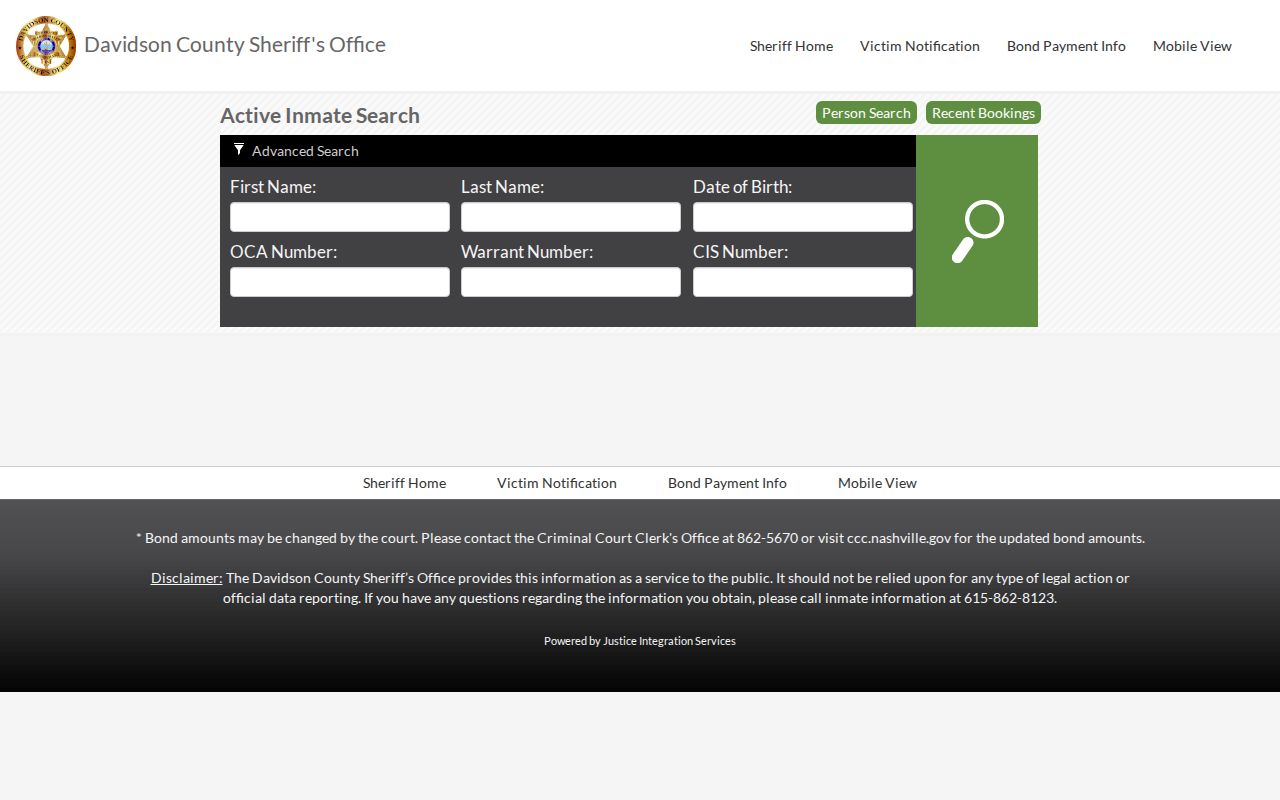
State felony custody and supervision records use TDOC FOIL, while the TBI registry has its own scope and misuse warning. The Sheriff records desk does not provide Metro police reports, crash reports, or mugshots. Those requests must go to the agency that keeps the exact report. For professional context, Verify.TN.gov routes users to state license checks. Board results may show a person's name, license number, profession, location, status, expiration, and public discipline. Fields differ by board. The linked state verification gateway helps identify the correct licensing board before a search.
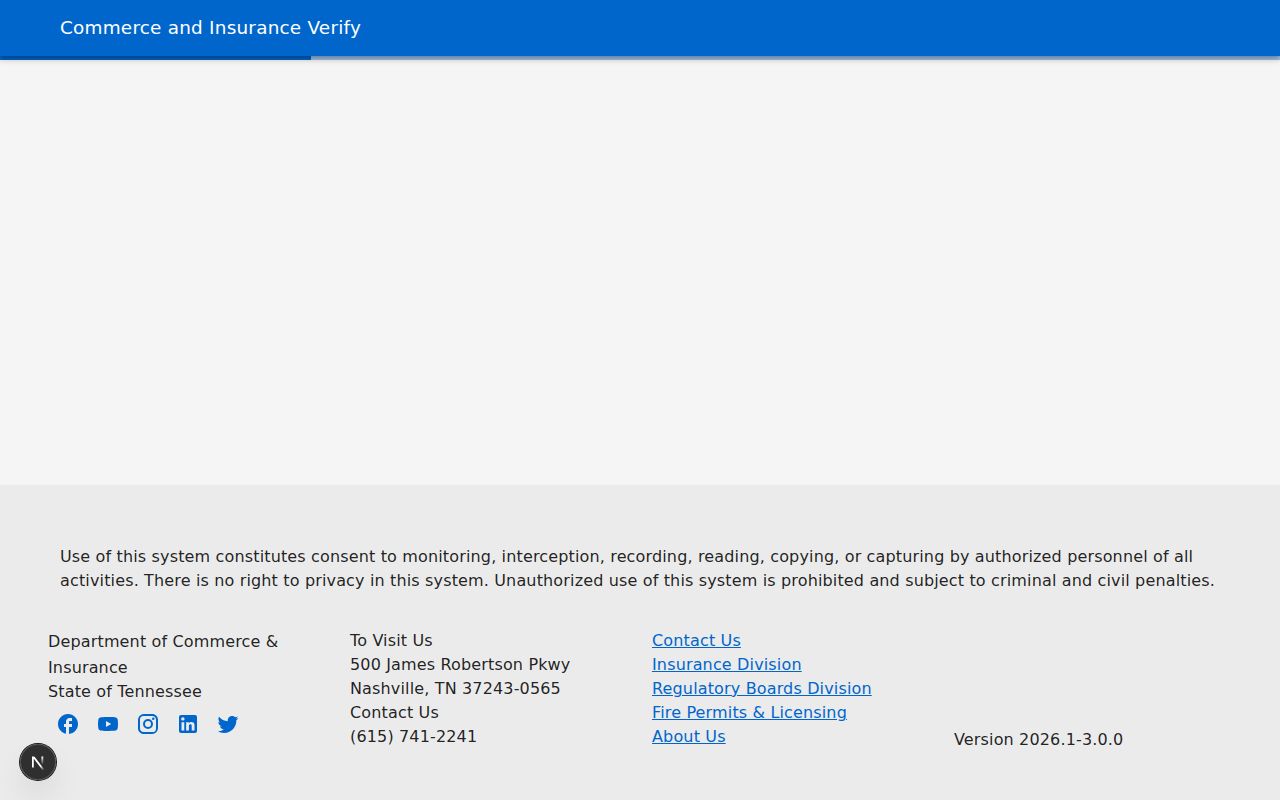
A current license can corroborate a name and city. It does not, by itself, prove that two same-name results belong to one person.
Find Nashville Vital Records
Current certified birth, death, marriage, and divorce records follow Tennessee eligibility and identification rules under the Vital Records Act, including TCA §68-3-205. The Tennessee Office of Vital Records and county health departments issue current certificates. A certified-copy search costs $15 and includes one copy if found; the fee is not refunded when no record is located. The current application controls payment, proof, and delivery requirements.
Custody shifts with age. Birth records transfer to Tennessee State Library and Archives after 100 years. Death, marriage, and divorce records transfer after 50 years. Davidson County Clerk is also a route for marriage licenses and copies, while a divorce certificate from Vital Records is different from the divorce case file held by the court.
Metro Archives adds local series: Nashville births from 1881 through 1913, Nashville deaths from 1874 through 1913, Davidson births from 1908 through 1912, Davidson deaths from 1900 through 1912, and marriage records from 1788 through 2017. When a certificate remains restricted, wills, probate, cemetery entries, and newspapers may still support family research without bypassing the law.
Nashville Archives Search Past Residents
Metro Archives genealogy collections reach far beyond a standard name directory. City directories span 1853 through 2011. Local wills indexes cover 1783 through 1963, yearbook holdings span donated material from 1900 through 2017, and court finding aids reach into the early county era. Newspapers, marriage indexes, cemetery files, naturalizations, maps, and photographs can separate people who share a name.
A deceased Nashville resident may appear in a probate case, a will index, a marriage record, a city directory, a cemetery entry, and an obituary. Search each spelling and record the role named in the source. Metro Archives' African-American Marriage Index, Nashville Globe obituary index, Mount Ararat reconstruction, and Enslaved and Free People of Color Database offer a focused path when older mainstream sources omit or misstate a family.
Most special-collection items are closed-stack and noncirculating. A Research Application and staff pull may be required, and no pulls occur during the last 15 minutes. Ancestry Library Edition is available only on a Nashville Public Library computer.
Nashville Address Search Changed in 1910
Nashville city directories are name-arranged from 1853 through 1909. Street-address searching begins in 1910. This change creates a useful bridge between a modern parcel and an older occupant, even when the occupant never owned the land. Start with Parcel Viewer ownership history, trace the deed chain, then switch to reverse directories for the target year.
Geography matters just as much as the year. Directories before Metro consolidation in 1963 did not cover all Davidson County, though some entries reached beyond the old city limits. A missing suburban address may reflect coverage rather than absence. Street renaming also complicates the trail: Cedar Street and Charlotte Avenue caused confusion, and a 1941 city-county effort removed duplicate names and made numbering more uniform.
Preserve the parcel ID and legal description when a street label changes. Historic Commission reports, plats, permits, Sanborn maps, photographs, and directory spellings can then be used as crosswalks.
Note: Before 1910, search the resident's surname first; after 1910, test both the person and the street address.
Nashville Permit Search Moved
Metro Codes ties people to buildings through construction, trade, short-term-rental, and property-standard records. Current ePermits searches include permit number, address, APN, owner, and contractor. Results can identify the permit type, address, property owner, contractor, status, inspections, and violation updates. This trail helps explain why a person or firm appears at a parcel without assuming residence or ownership.
Codes Permit reports stopped updating in the older Document of Record portal after May 15, 2026. Current research should begin with Metro Codes records and information, ePermits, or the linked open-data sets. The older form remains useful for its query logic: partial street names may work, suite data can be incomplete, and parcel numbers keep all zeroes without punctuation.
When an online permit query fails, contact Metro Codes at 800 President Ronald Reagan Way or submit a Metro public-records request. That fallback preserves an address trail that a portal migration might otherwise hide.
Nashville Business Records Identify Roles
The Davidson County Clerk's New Business List can be filtered to Davidson County and sorted by business name, owner name, or date. Tennessee Secretary of State filings add entity status, type, principal office, registered agent, and filing history. A registered agent accepts legal service; that role does not prove ownership or residence.
Use the exact legal name and test variants. Tennessee calls a secondary operating name an “assumed name.” UCC records can connect debtor and secured-party names, while Verify.TN and board portals confirm professional-license status. Permits may name both the project owner and contractor. Each source records a different role, so combining them is stronger than treating any one entry as a full personal profile.
ClaimItTN offers a different lead. Tennessee holds abandoned property until the owner or legal beneficiary claims it, and the name search is free. A match may support an heir or estate inquiry, but the claim process must verify identity.
Nashville Voter Search Confirms Status
The Tennessee voter lookup is an identity-checked tool, not a browsable list of Nashville residents. A voter supplies Davidson County, first name, last name, birth month, and birth year to confirm registration and voting logistics. GoVoteTN offers voter and address routes for sample ballots, polling places, districts, and early-voting facts.
A failed match is not proof that someone is unregistered. Names should match the registration card, and the Davidson County Election Commission handles corrections, inactive status, and missing results. Ballot choices are never part of a voter record. Tennessee also has no permanent party registration, so primary participation is not a party label.
The full public and confidential split, list-order limits, Safe at Home treatment, and office fallback appear with the Nashville voter records lookup.
Nashville Courthouse Fire Left Records
Davidson County's three-story courthouse burned in 1856, but the event did not erase every early record. County Court minutes survive from 1783, and early deeds and wills remain. Calling Davidson a “burned county” creates a false blanket gap and may stop research too soon.
Use the exact surviving series and finding aid. Metro Archives lists County Court minutes through 1960, Circuit material beginning in the early 1800s, and Chancery records from the mid-1800s. Early person searches may depend on legal descriptions, waterways, neighbors, witnesses, kin, tax entries, and church material because modern street addresses did not exist.
This record survival also explains why an offline box, reel, or index can matter more than a current portal. Digital absence is not evidence that the Nashville record never existed.
Protect Nashville Search Subjects
Government records can contain sensitive facts even when the record itself is open. Tennessee custodians may redact Social Security numbers, account identifiers, protected addresses, health details, information about minors, and sealed or expunged content while releasing the rest. Ask for the legal citation and a redacted copy instead of assuming a whole file is closed.
Safe at Home gives eligible survivors a substitute address for government transactions. It does not erase old records or guarantee that private publishers remove a prior address. Real-property assessment, tax, and recorded-document exceptions also mean enrollment should never be described as hiding ownership.
Commercial opt-outs affect the publisher's compilation, not the official deed, case, license, or parcel source. Save removal confirmations, recheck name variants, and contact the custodian for lawful corrections to government records. Use every result for a lawful personal purpose and verify it before relying on it.